Traffic flow operations study how movement emerges from interaction, between vehicles, pedestrians, infrastructure, control rules, and human decision-making, under conditions that are inherently noisy, heterogeneous, and only partially observable. Across motorway corridors, weaving sections, and unsignalized urban crossings, my work approaches traffic flow as a complex dynamical system, where macroscopic patterns such as congestion, instability, and capacity loss arise from microscopic decisions like lane changes, gap acceptance, and speed adaptation. Understanding these systems requires more than descriptive analytics: it demands the reconstruction of latent states, the modelling of interaction mechanisms, and the quantification of uncertainty across space and time.
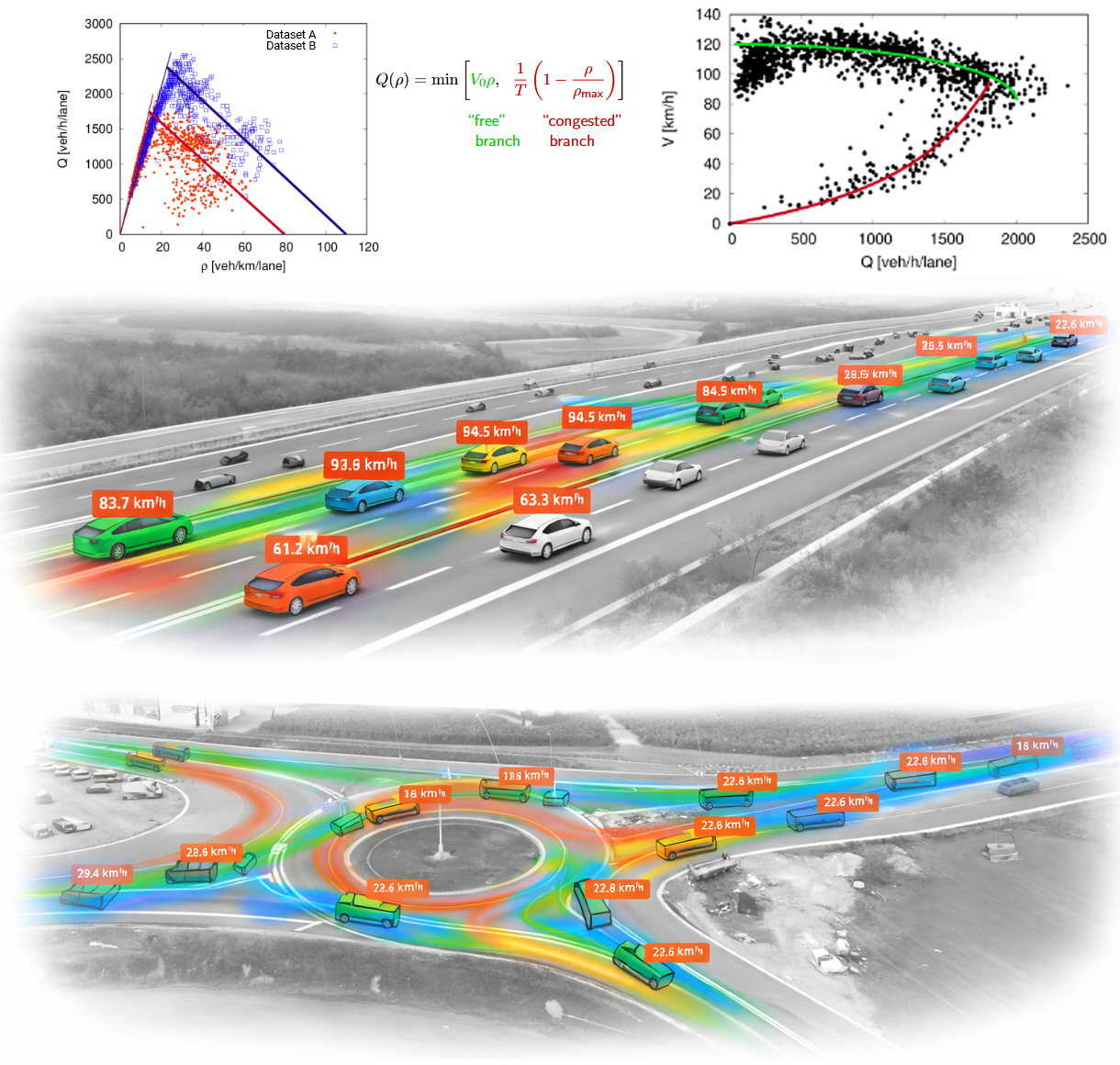
A central theme of my projects related to traffic flow operation is the translation of raw, imperfect observations into operationally meaningful system states. Using high-resolution loop-detector data, video observations, and reconstructed trajectories, I developed and calibrated advanced spatiotemporal estimation frameworks to infer travel times, speed fields, and congestion patterns at a resolution suitable for individual-level analysis. This includes adapting and optimizing filtering techniques under different traffic regimes, integrating optimization algorithms where classical assumptions fail, and validating models against independent ground truth. These methods enable lane-level, regime-aware inference in environments dominated by stochasticity, nonlinear dynamics, and strong interdependencies, conditions common to many real-world systems beyond mobility.
Equally important is the explicit modelling of behavior and interaction. My work spans the analysis of interactions between motorized and non-motorized modes, captured through hybrid statistical models that combine latent variables and structural equation modelling, to motorway traffic, where lane changes act as high-impact, system-level perturbations. By analyzing how local maneuvers propagate through the network, my projects reveal how individual incentives, constraints, and heterogeneity shape collective outcomes. The methodological backbone blends advanced statistics, optimization, and behavioral modeling, ensuring interpretability while preserving realism.
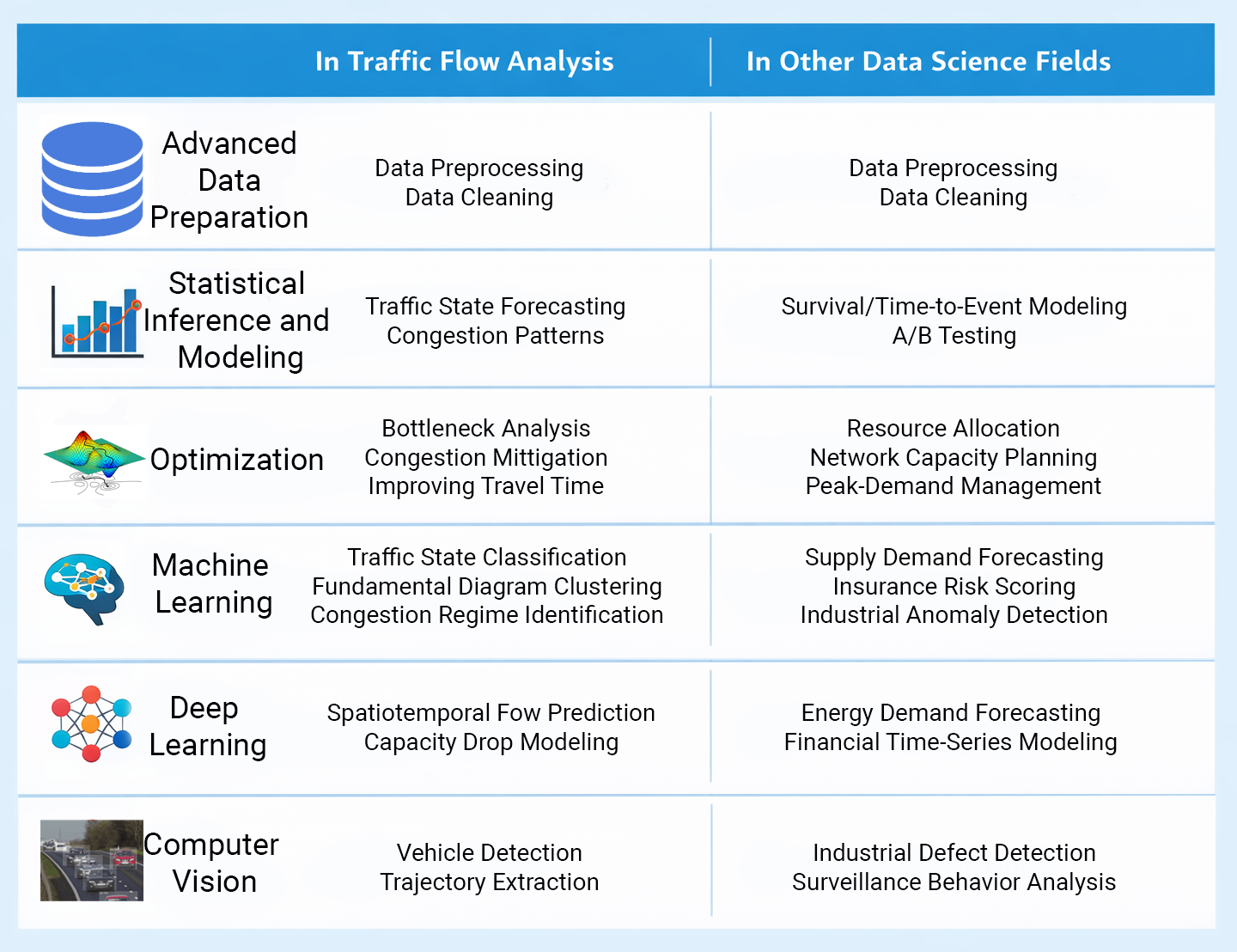
Beyond mobility and transportation, these projects demonstrate a transferable skill set for data-intensive, high-dimensional systems where signals are sparse, uncertainty is structural, and decisions interact across scales. The same techniques: state estimation, optimization under constraints, regime-dependent modelling, behavioral inference, and robust validation, apply directly to domains such as industrial operations, financial markets, human-AI systems, safety-critical analytics, and large-scale decision support. Traffic flow operations, in this sense, serve not merely as an application domain but as a laboratory for developing data-science methodologies that explain, predict, and ultimately shape complex systems under real-world uncertainty.
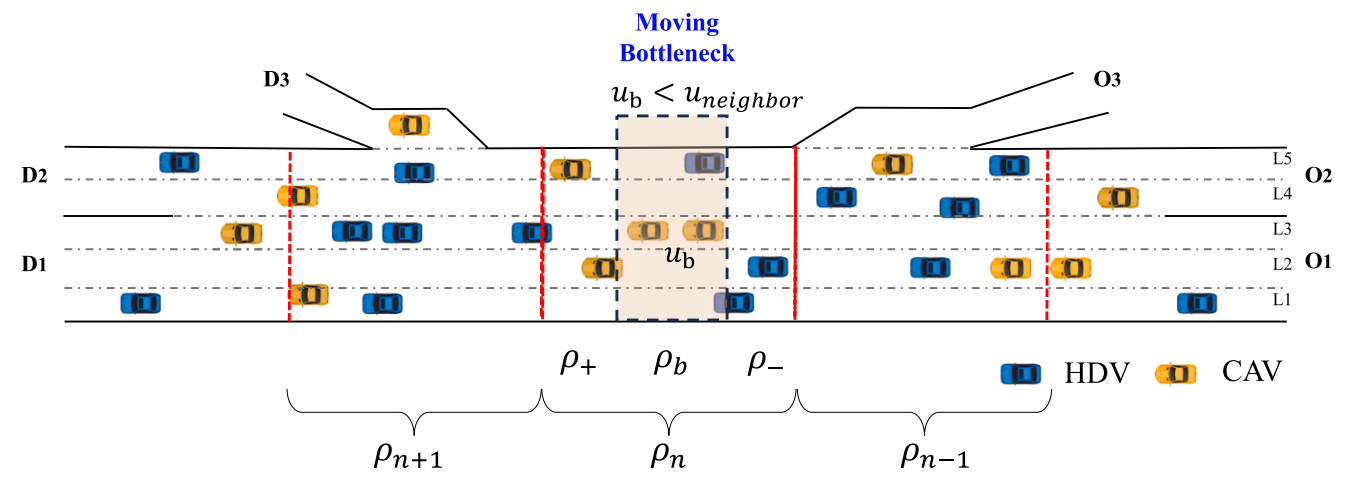
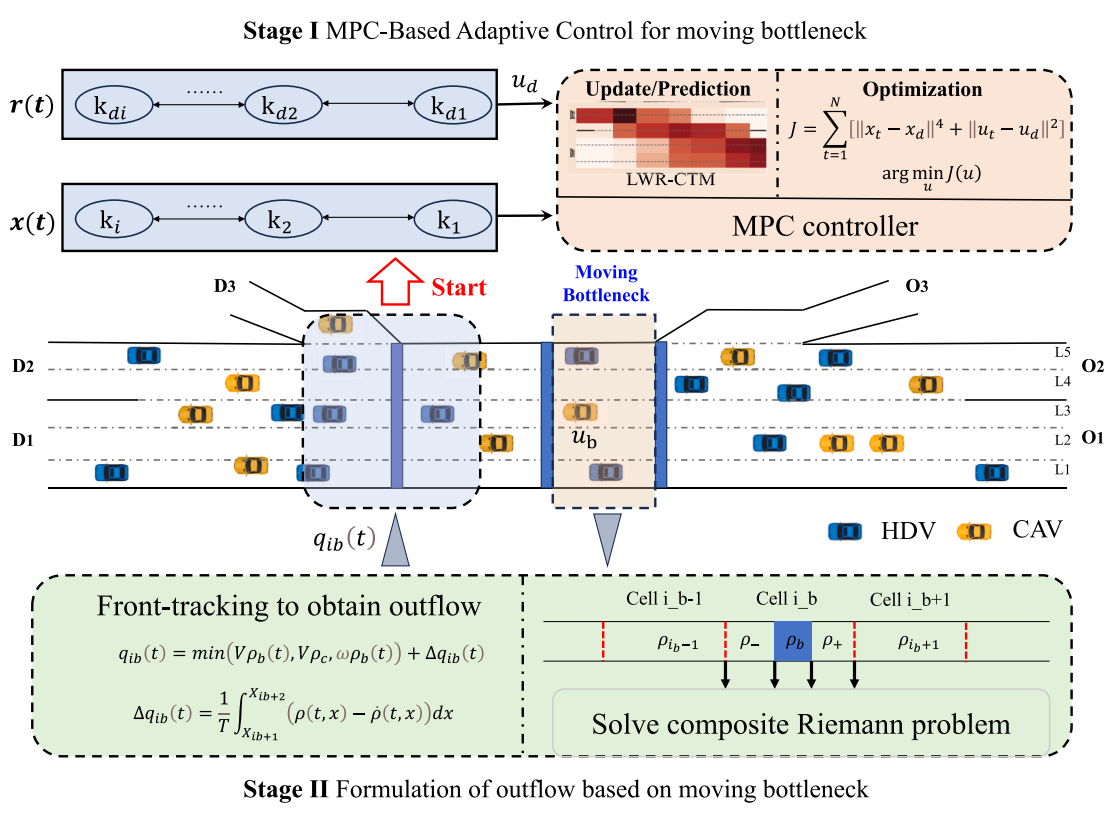
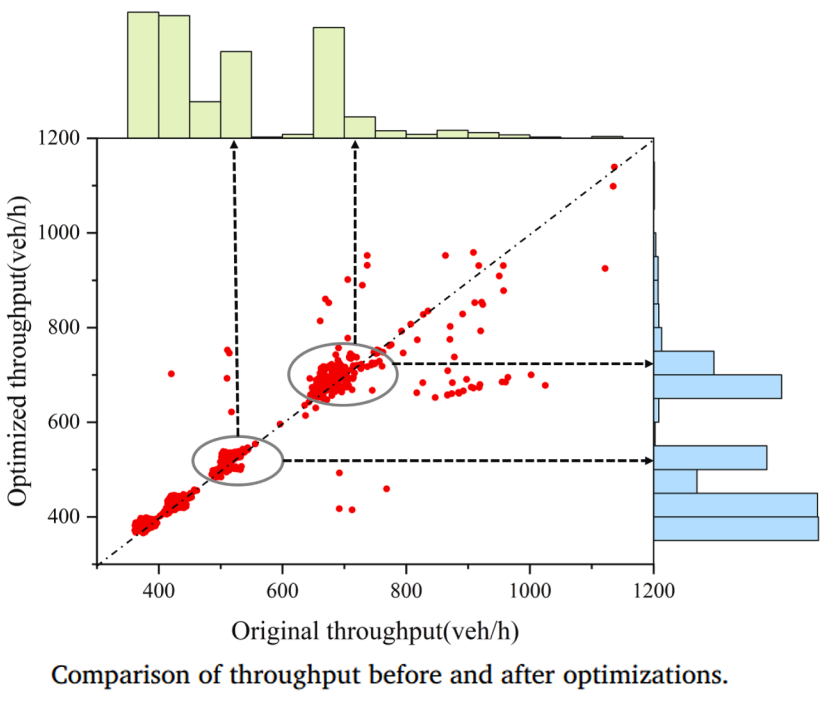
This project addresses a fundamental operational challenge in modern traffic systems: how to actively mitigate congestion in mixed traffic environments where connected and automated vehicles (CAVs) coexist with human-driven vehicles. Rather than assuming full automation or idealized compliance, the work explicitly embraces partial penetration, uncertainty, and human heterogeneity. The motivation is pragmatic and systemic: even a small fraction of controllable agents, if properly orchestrated, can reshape traffic dynamics at the network level. By designing a control framework that operates directly on traffic flow evolution, the project demonstrates how congestion can be dampened, shockwaves attenuated, and overall efficiency improved without relying on infrastructure expansion. The importance of this work lies in its relevance to near-term deployment scenarios and its applicability to traffic management, active control strategies, and the transition toward intelligent mobility systems.
Methodologically, the project is grounded in a rigorous, physics-informed modeling framework that couples macroscopic traffic flow theory with adaptive control. Traffic dynamics are represented using conservation laws, with the front-tracking method employed to accurately capture discontinuities, nonlinear wave interactions, and regime transitions that standard numerical schemes often smear or misrepresent. On top of this high-fidelity representation, a two-stage adaptive CAV control strategy is developed: one stage focused on stabilizing traffic states and suppressing congestion formation, and a second stage refining control actions based on evolving system conditions. The framework is analytically consistent, computationally efficient, and explicitly validated under varying traffic compositions. This combination of theoretical soundness, numerical precision, and adaptive decision-making reflects an advanced level of transport system modeling, where control design, data-driven calibration, and system dynamics are treated as an integrated whole rather than isolated components (Expert Systems with Applications - 2026).
Beyond transportation, the project exemplifies a transferable approach to controlling complex, nonlinear, and partially observable systems under uncertainty. From an industrial and data-science perspective, the ability to model system dynamics, identify leverage points, and design adaptive interventions using limited control authority is broadly applicable to domains such as manufacturing flows, energy systems, logistics, and large-scale operations management. The results demonstrate how modest, well-targeted control actions can yield disproportionate system-level benefits—a principle that resonates across many data-driven decision environments. The skills exercised in this work—state evolution modeling, hybrid physics-based and data-informed control, scenario-robust validation, and interpretable performance assessment—translate naturally to any setting where complex systems must be steered toward stability, efficiency, and resilience without oversimplifying their underlying dynamics.
This project tackles one of the most disruptive and least predictable components of traffic flow operations: lane-changing behavior in motorway weaving areas. These locations concentrate competing incentives, route continuation, merging, diverging, and speed adaptation, within constrained space and time, making them a dominant source of turbulence, capacity drop, and safety risk. Rather than treating lane changes as exogenous disturbances or purely microscopic decisions, the project reframes them as aggregate behavioral choices that shape macroscopic traffic evolution. The motivation is both operational and scientific: weaving areas are where conventional flow models break down, and understanding how lane-change demand emerges and redistributes across lanes is essential for reliable traffic prediction, control, and infrastructure design.
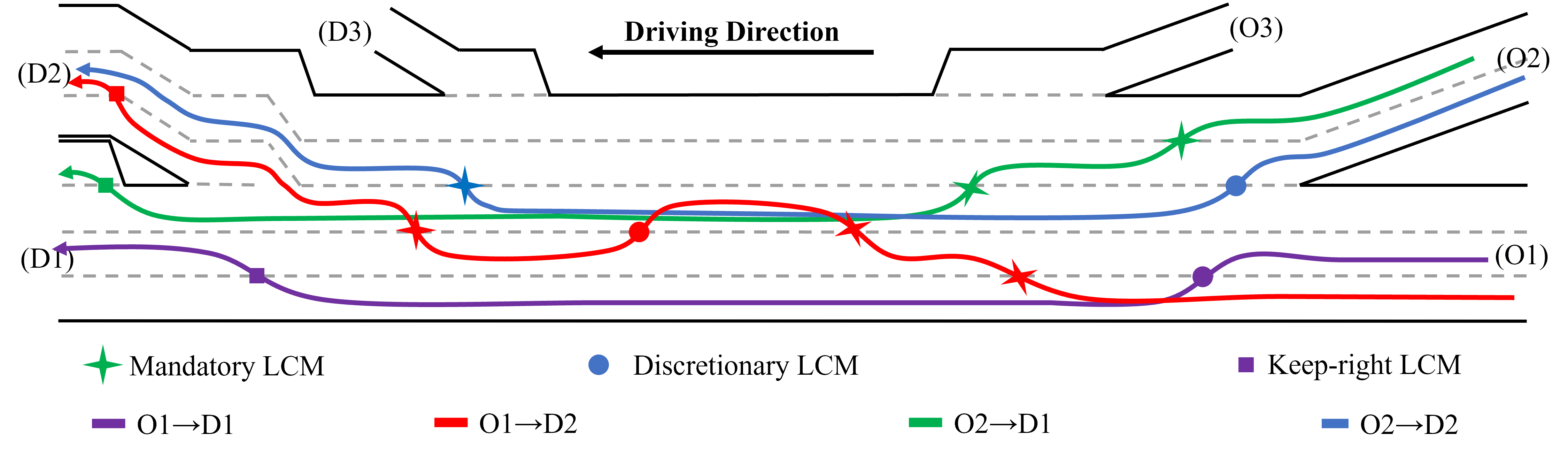
Classification of LCMs into three types. Stars represent mandatory LCMs, circles depict discretionary LCMs, which are non-mandatory LCMs towards the left, and squares illustrate keep-right LCMs, which are non-mandatory LCMs towards the right. Lines represent four exemplary trajectory paths, each for one of the main OD paths inside the test weaving section, to help clarify different types of LCMs given the maneuver direction, origin, and destination of trajectory inside the weaving area.
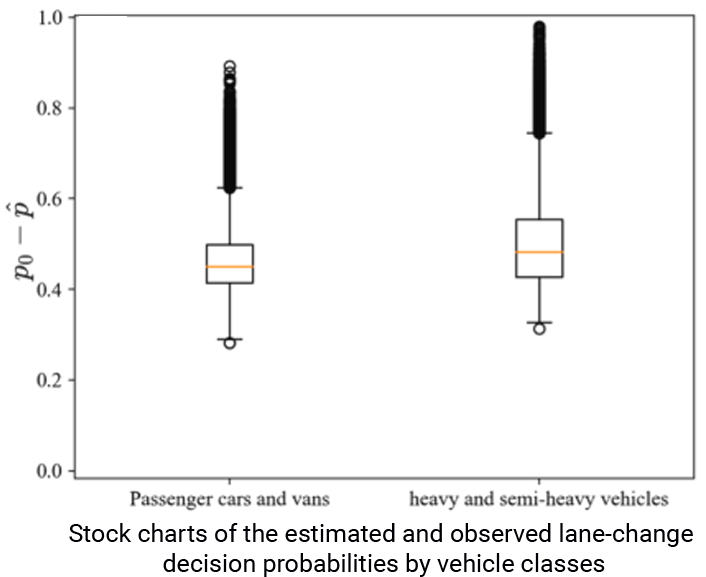
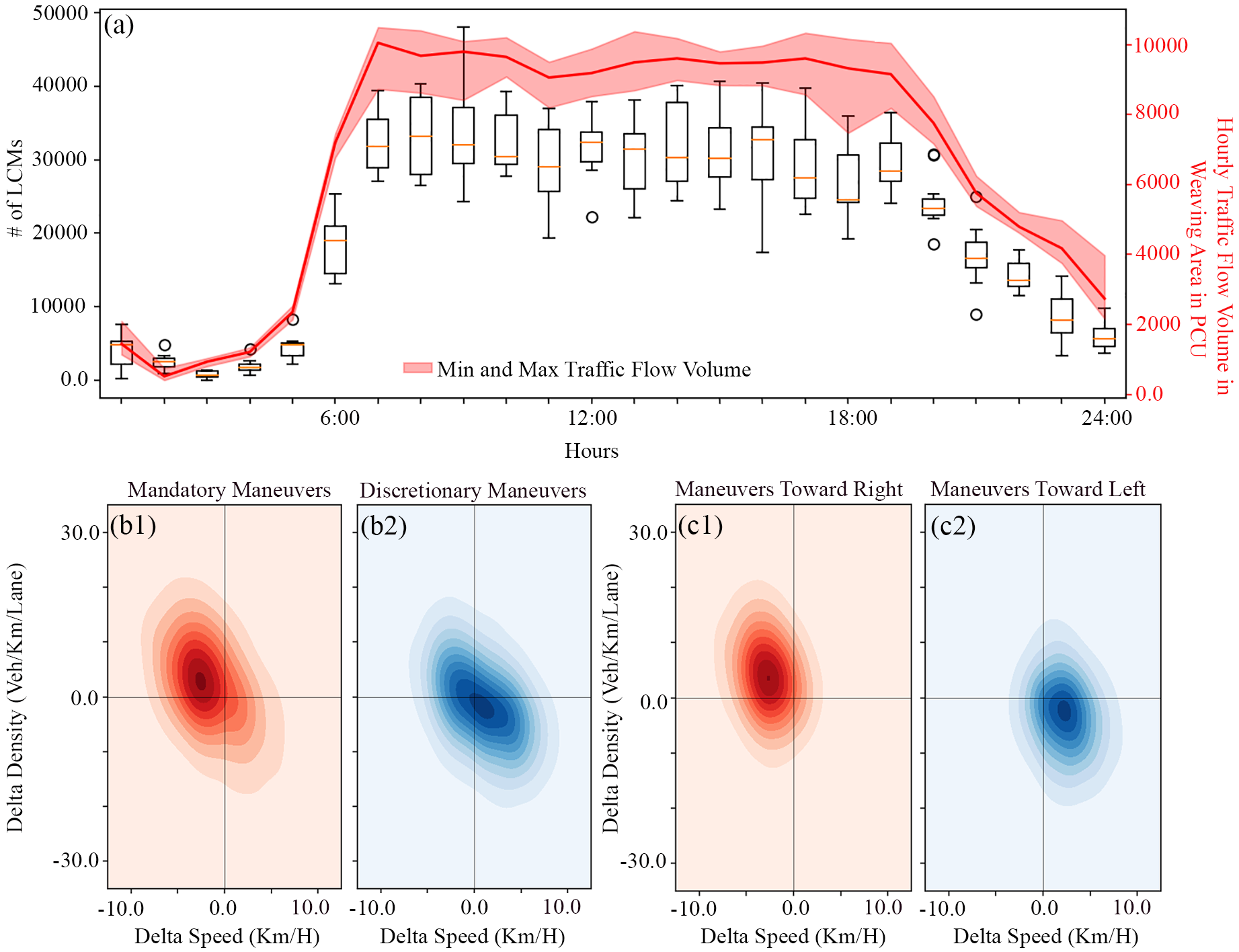
Methodologically, the project introduces a choice-based macroscopic lane-change prediction framework grounded in behavioral modeling and statistical inference. Lane-change demand is modeled as a probabilistic choice process, explicitly linking observable traffic states, such as lane densities, speeds, and relative utilities, to aggregate lane-changing flows. By embedding discrete choice principles into a macroscopic traffic representation, the model preserves behavioral interpretability while remaining compatible with network-level analysis. The framework is rigorously estimated and validated using empirical data from weaving sections, demonstrating its ability to reproduce both spatial and temporal patterns of lane-changing activity. This combination of behavioral theory, statistical estimation, and macroscopic consistency reflects an advanced level of transport modeling where human decision-making is treated as a structured, quantifiable driver of system dynamics. (Transportation Research Part C: Emerging Technologies - 2024).
To further assess the operational implications of the proposed model, the project incorporates simulation-based analysis that embeds the predicted lane-change demand into traffic flow evolution. By coupling the choice-based lane-change model with macroscopic traffic dynamics, the simulation allows the propagation effects of lane-changing activity to be examined in space and time, revealing how local behavioral choices translate into congestion formation, capacity loss, and flow redistribution across lanes. This integration is critical: it moves the model beyond static prediction and into dynamic system analysis, where feedback between behavior and traffic states can be observed and quantified. From a broader perspective, this simulation-based extension demonstrates how behaviorally grounded models can be operationalized within decision-support tools, enabling scenario testing, infrastructure evaluation, and policy analysis in environments where interactions between demand, capacity, and human choice play a central role.
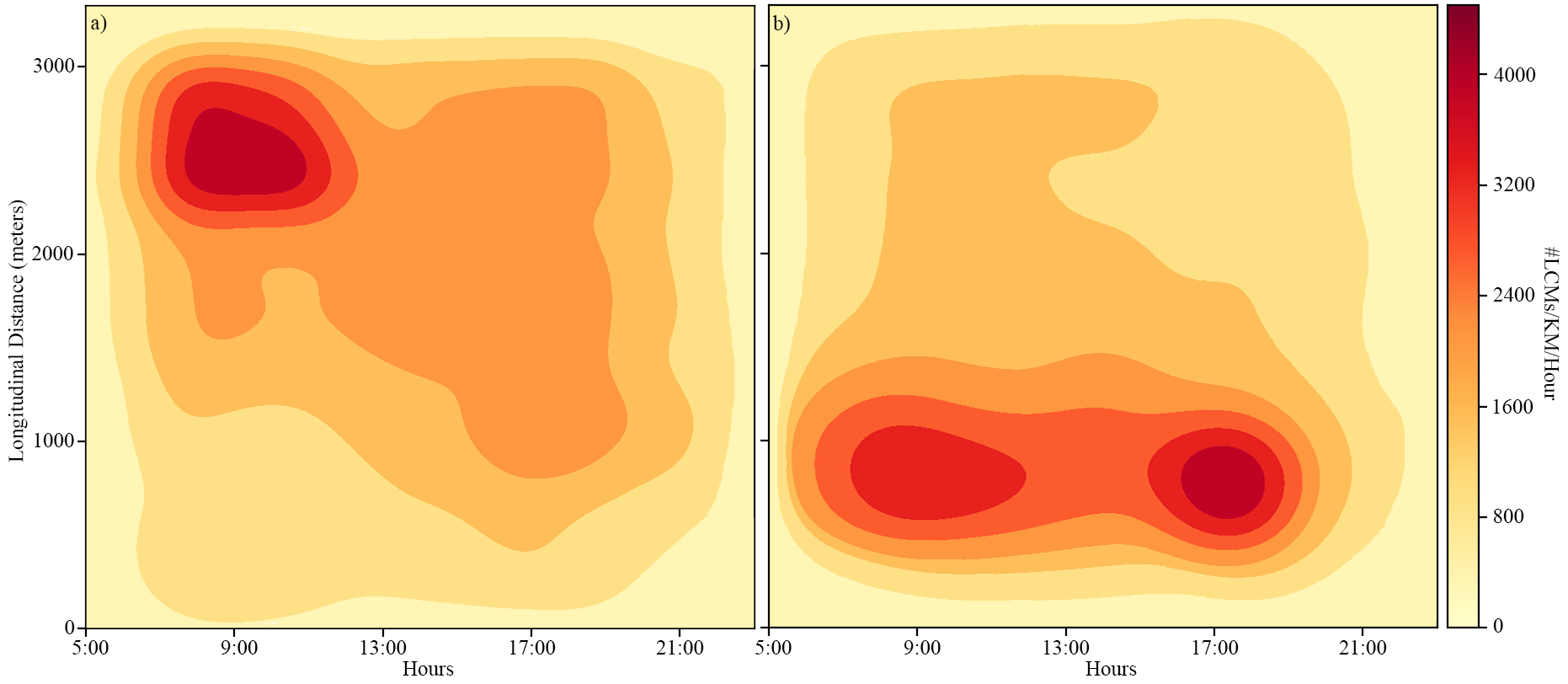
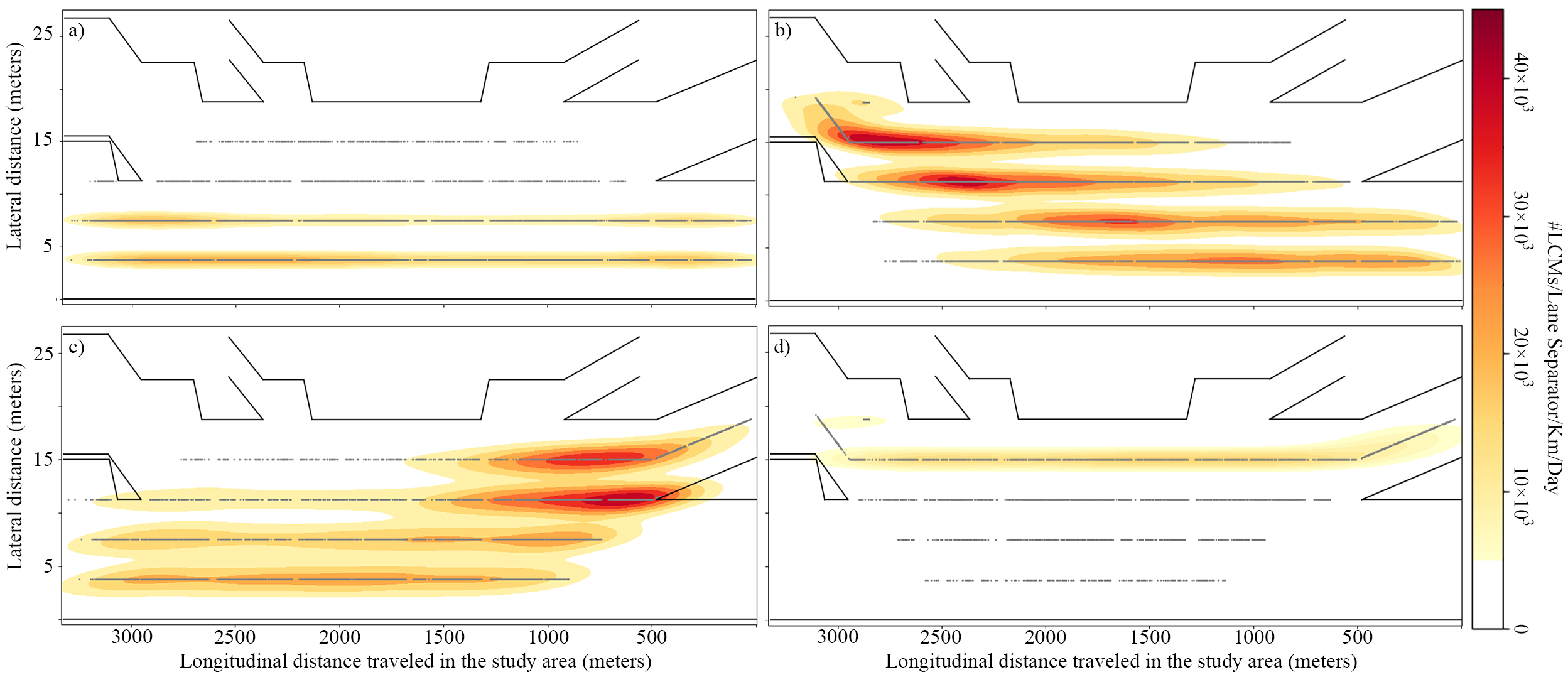
The spatio-temporal scattering of LCMs of the weaver drivers, a) O1 → D2, b) O2 → D1 (see figure above for origin and destination labeling in this project).
Beyond transportation, this project exemplifies how complex collective behavior can be inferred and predicted from noisy, aggregated observations. From an applied data-science perspective, the work demonstrates how discrete choice modeling, probabilistic demand estimation, and system-level validation can be combined to forecast high-impact events without relying on individual-level tracking. The resulting methodology is directly transferable to domains where competing options, constraints, and incentives drive collective outcomes, such as logistics routing, capacity allocation in networks, or resource competition in operational systems. The project highlights how interpretable, choice-based models can support decision-making, scenario testing, and policy evaluation in environments where behavior matters as much as physical constraints.
This project focuses on empirically uncovering how lane-changing maneuvers unfold in motorway weaving areas, where traffic flow is shaped by dense interactions, competing route choices, and spatial constraints. Weaving sections are among the most operationally critical parts of the network, as frequent lane changes amplify turbulence, reduce capacity, and increase safety risk. Rather than relying on idealized assumptions or simulation-only representations, this study is grounded in observed behavior, aiming to reveal how real drivers execute lane changes under different traffic conditions. The core motivation is to provide a data-driven understanding of lane-changing dynamics that can support more realistic modeling, calibration, and operational assessment of traffic flow in complex motorway environments.
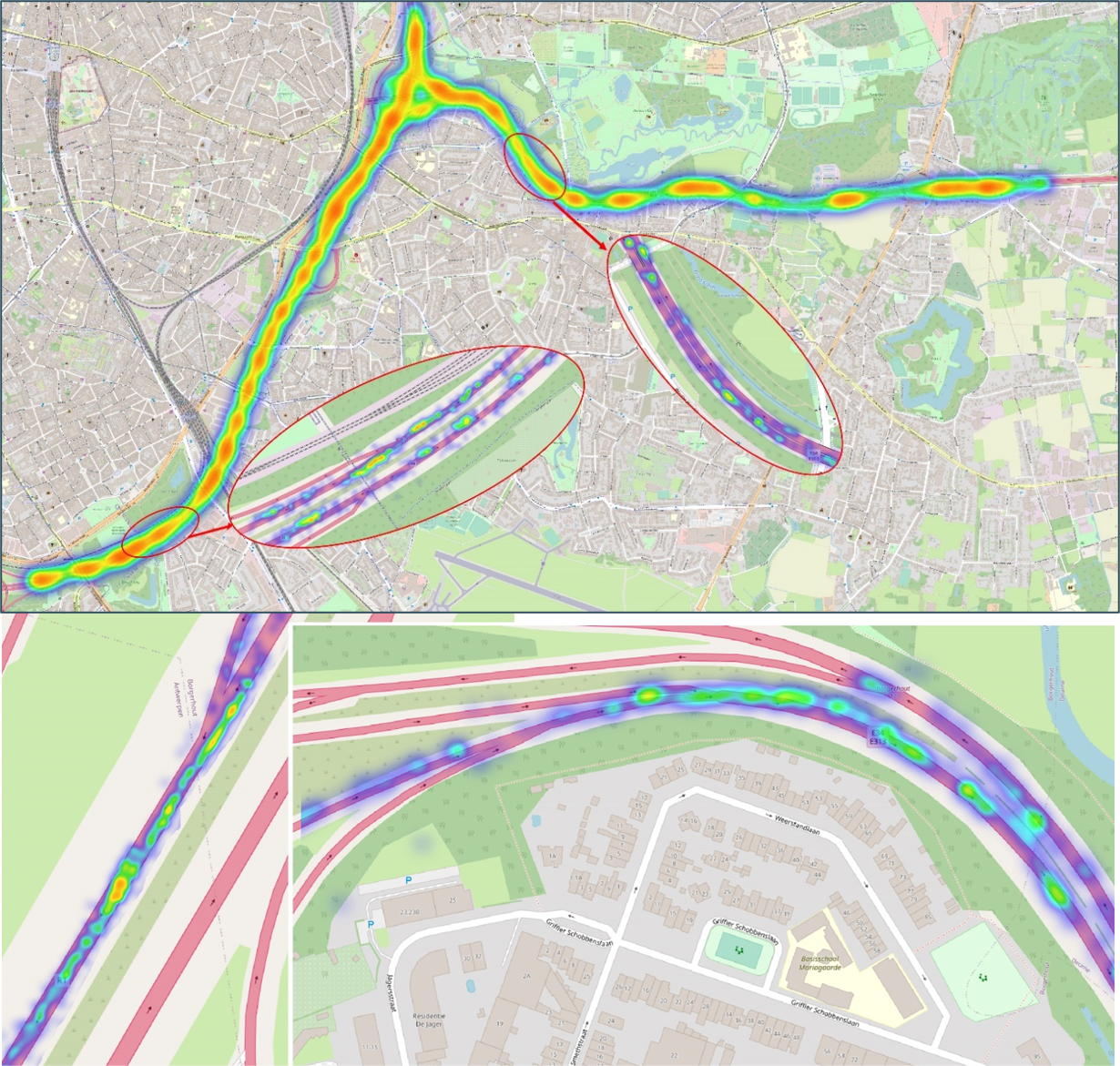
Methodologically, the project is built on the reconstruction of high-resolution vehicle trajectories from floating car data (FCD), enabling detailed empirical analysis at the maneuver level. By inferring continuous vehicle trajectories from sparse and imperfect observations, the study recovers the timing, location, duration, and surrounding traffic context of lane-changing maneuvers across weaving segments. This reconstruction allows lane changes to be analyzed not as isolated events, but as embedded processes influenced by local density, speed differentials, and lane-specific conditions. The analysis systematically characterizes how lane-changing behavior varies across traffic regimes and spatial zones within the weaving area, demonstrating a rigorous approach to extracting behavioral insight from noisy, large-scale observational data (10th Symposium of the European Association for Research in Transportation hEART - 2022, Transportation Research Board 102nd Annual Meeting -2023, Transportation Research Record - 2023).
Beyond its immediate traffic-engineering relevance, this project illustrates how complex interaction behaviors can be empirically inferred from incomplete and indirect data sources. From a broader data-science perspective, the work exemplifies state reconstruction, event detection, and context-aware behavioral analysis in systems where direct measurement is unavailable or impractical. The methodology, combining trajectory reconstruction, statistical characterization, and regime-dependent analysis, is directly transferable to domains such as human–machine interaction, and operational monitoring of large-scale systems. By grounding behavioral modeling in reconstructed reality rather than assumptions, the project strengthens the link between empirical evidence, model development, and decision support.